
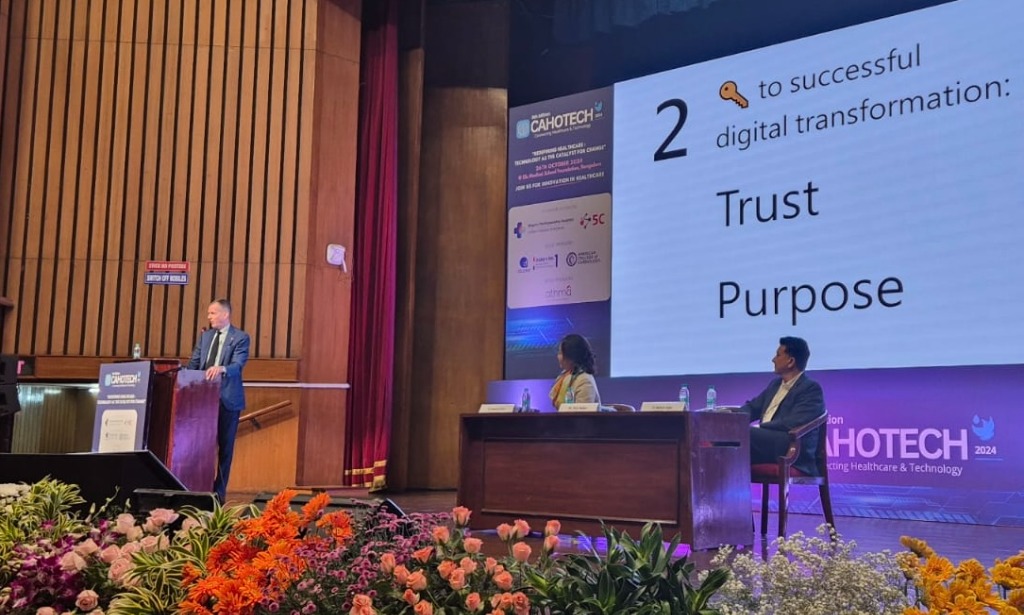
I would like to talk to about two ingredients for successful digital transformation: trust and purpose. I have provided some references at the end which support and amplify my personal lessons learned, but what I will share with you reflects my experience over the past 28 years, working with clinical and other end users on technology adoption.
Trust and purpose are very important. I’ll relay a story from early in my career. The year is 1998. I'm in Kaiser Permanente’s South San Francisco Hospital, which is 120-bed hospital. I'm working in the IT department and we're deploying IBM mainframe terminals to exam rooms for physicians. We go to the pediatrics department and we're pushing our little cart with these terminals on it and installing them in the exam rooms. We get to this one exam room in pediatrics and there's this very tall imposing gentleman, Dr. Nuremberg, standing in the doorway of the exam room and he says “No! I'm not going to let you put that machine between me and my patient.” This was my first experience with resistance to change in the clinical environment.
We were trying to give him access to the Clinical Information Presentation System (CIPS), a powerful early medical record system, a precursor to CPOE systems, which contained lab data, problem lists, transcribed reports, preventive health prompts as well as summaries of outpatient visits, hospitalizations and ED visits, all available at the fingertips of clinicians.
People always talk about how people inherently resist change, but I think change resistance in this case can be about two things; it can be about a lack of involvement, and it can be about a lack of autonomy. You need to pay attention to people’s involvement in the change and their involvement in the decisions around the change. You also need to pay close attention to autonomy. In the healthcare delivery context, autonomy is very important because it is a hallmark of physician culture. I think we need to provide a lot more autonomy to our colleagues as we encourage them to embrace change.
The Power of "The Frame"
Purpose is another essential ingredient in any successful digital transformation. Purpose is largely determined by the frame that we place on things. A frame is a perspective organized by assumptions and expectations that influences how we see the world. Digital transformation in healthcare is often looked at through the frame of quadruple aim, but you could have other frames.
For example, addressing inequities in the healthcare delivery system might be a frame, solving for social determinants of health might be a frame, or maximizing revenue might be a frame. The thing about frames is that each one of us is carrying around a unique stack of frames. Each person reading this is carrying around their own stack of frames. Frames are usually invisible to us but may be apparent to others. Diverse frames are healthy and encourage multiple sources of meaning (purpose).
Cultures impact frames. In the healthcare context you have many different micro cultures, professional cultures, and occupational cultures driving the frames through which people perceive a digital transformation. As you build your transformation team, try to find a healthy mix of members from different occupational and professional cultures. National culture diversity is also important. Find as many different people with as much diversity as you can. Avoid populating your transformation team with “same-frame” thinkers.
"Maintaining humility and adopting a beginner's mind is helpful. Set the tone by encouraging and supporting junior team members to call into question the frames of your experts."
Clashing Frames: IT vs. Clinical
How did the frames clash in the story about me meeting this pediatrician in the doorway of his exam room? Well, his frame was, “you guys are IT, you're not part of my organization and you're not on the same mission that I'm on. I'm here to take care of my patient. I'm here to have a human interaction with my patient.” And, looking at him, our frame was, “we're providing this wonderful tool for you to have the patient information at your fingertips.” That was a clash of different frames. Frames are about purpose. The frame, the purpose, the meaning are all in the same constellation.
Motivation, Ability, and Trust
Most transformation efforts will require some behavior change. I'm referencing B.J. Fogg. B.J. Fogg works at the Stanford Decision Lab, where one of the two inventors of Instagram was trained. B.J. Fogg says that, in fostering new behaviors, motivation is primary, followed by ability, followed by prompts.
If your leadership can convey to people a purpose that resonates with their highest selves, something that everybody resonates with, you will appeal to their intrinsic motivation. In healthcare we always hear stories about being a patient or having a patient in your family. This also touches the heart. The affective dimension is critical when articulating the purpose. We cannot pretend to be solely about technical or financial matters; digital transformation is about doing our job while yet simultaneously honoring and acknowledging our emotions.
B.J. Fogg recommends focusing your effort on the ability of target audience. Ability is important. We call this activity of focusing on their ability “enablement.” And this brings me to my second key ingredient for successful digital transformation: trust. Why is trust important? How do we get to a space where we trust each other?
If I learn a little bit more about people I work with, I can gain their trust. In getting to trust, you want to get to know the people that you're working with. If we can get to a level two relationship, perhaps when we begin to do a project together, we'll have a level of trust that will enable us.